
Ynglŷn ag Ymchwil ar Waith
Mae Ymchwil ar Waith, o fis Hydref 2024 ymlaen, yn rhan graidd o’r PhD ar gyfer pob myfyriwr newydd sy’n derbyn ysgoloriaethau ESRC yn Ysgol Graddedigion Gwyddorau Cymdeithasol Cymru (YGGCC). Mae Ymchwil ar Waith yn cynnig cyfle i gymryd rhan mewn profiadau datblygu ymarferol, gan gynnwys lleoliadau o fewn sefydliadau academaidd neu anacademaidd. Mae’n rhan annatod o’ch taith PhD, a gynlluniwyd i wella eich sgiliau ymchwil a phroffesiynol mewn cyd-destunau newydd.
Amcanion
Mae’r lleoliad Ymchwil ar Waith wedi’i gynllunio i’ch helpu i:
- Datblygu sgiliau craidd, proffesiynol a throsglwyddadwy
- Cymhwyso gwybodaeth ddamcaniaethol ac arbenigedd methodolegol mewn cyd-destunau amrywiol
- Cael effaith yn gynnar yn eich gyrfa academaidd neu broffesiynol drwy fynd i’r afael â heriau’r byd go iawn
Gall buddion ychwanegol gynnwys y canlynol:
- Adeiladu rhwydweithiau proffesiynol
- Ennill profiad mewn entrepreneuriaeth ac arloesi
- Cyfrannu at ddatblygu polisïau
- Gwella sgiliau ymgysylltu â’r cyhoedd
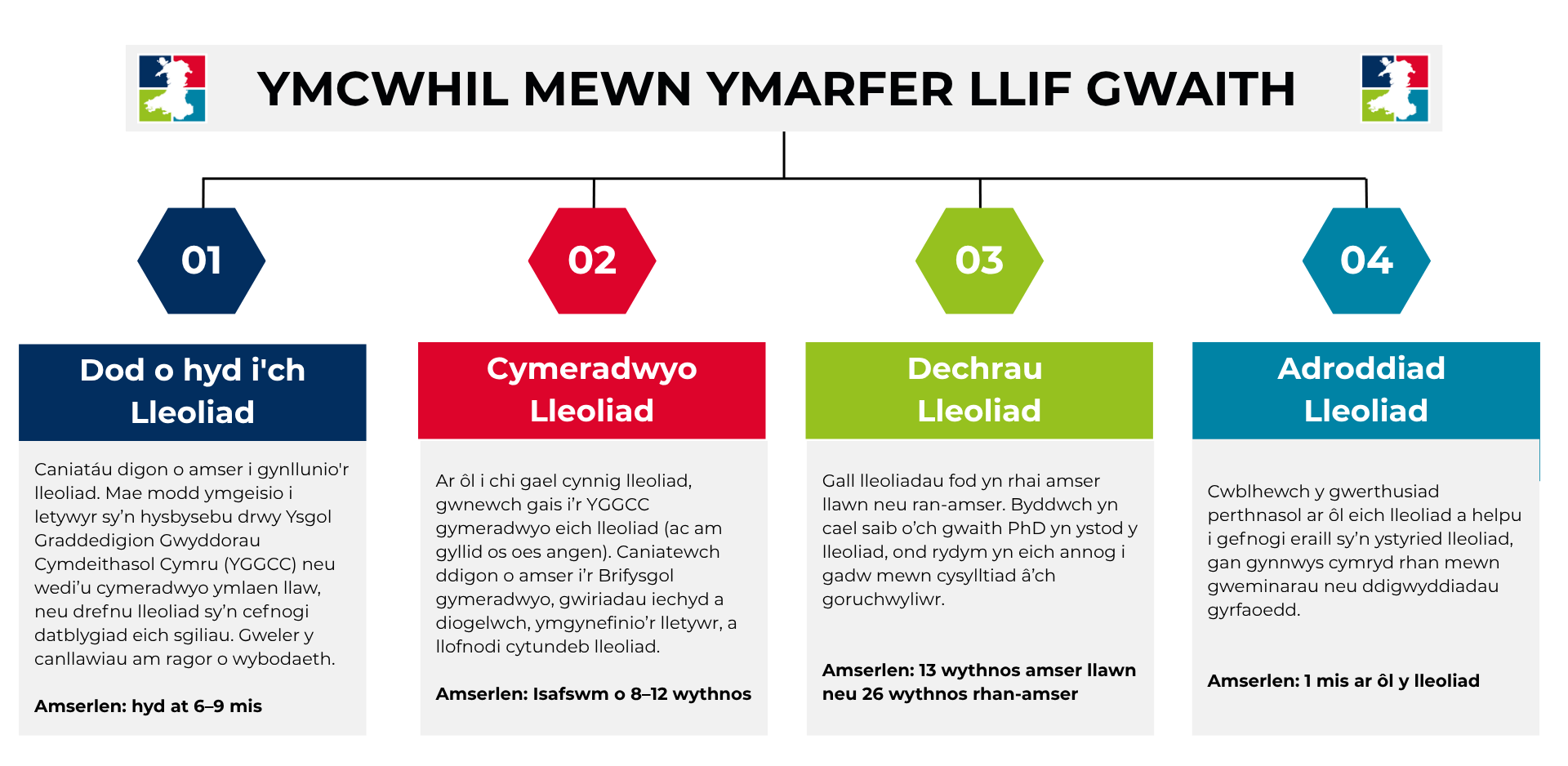
Proses Cam wrth Gam

Barod i ddechrau eich taith lleoliad? Cliciwch y saeth wrth ymyl pob cam i weld canllawiau:
Cam 1 – Paratoi
Mae dod o hyd i leoliad yn gofyn am waith paratoi. Cyn i chi ddechrau chwilio am gyfleoedd, rydym yn argymell cwblhau’r gweithgareddau canlynol.
Beth i’w wneud
Ewch i sesiwn wybodaeth Ymchwil ar Waith Ysgol Graddedigion Gwyddorau Cymdeithasol Cymru.
Cyflwynir y sesiynau ar-lein hyn bob semester a’u hysbysebu drwy gylchlythyr misol Ysgol Graddedigion Gwyddorau Cymdeithasol Cymru a’r sianel Teams. Mae sesiynau’n rhoi trosolwg o’r cynllun a chyfle i ofyn cwestiynau.
Hysbysebir sesiynau bob mis yng nghylchlythyr Ysgol Graddedigion Gwyddorau Cymdeithasol Cymru, neu anfonwch e-bost at esrcrip@bangor.ac.uk i ofyn am gyfarfod un-i-un.
Trafod amseriad y lleoliad gyda’ch goruchwyliwr/goruchwylwyr
Cyn gwneud cais am leoliad, trafodwch eich cynlluniau gyda’ch goruchwyliwr/goruchwylwyr.
Ystyriwch:
- Eich amserlen ymchwil a cherrig milltir allweddol
- Gofynion adolygiad symud ymlaen
- Pryd fydd lleoliad yn cael yr effaith leiaf ar eich ymchwil PhD
Adolygwch eich Dadansoddiad Anghenion Datblygu. Dylai eich lleoliad gefnogi eich datblygiad proffesiynol a’ch nodau gyrfa hirdymor.
Ystyriwch:
- Pa sgiliau ydych chi eisiau eu datblygu?
- Meysydd lle byddech yn elwa o brofiad ychwanegol
- Sut gall lleoliad gyfrannu at eich cynlluniau gyrfa yn y dyfodol
Diweddarwch eich CV a’ch deunyddiau cais
Diweddarwch eich CV ac adnewyddu eich sgiliau ymgeisio a’ch sgiliau cyfweld. Gall Gwasanaeth Gyrfaoedd a Chyflogadwyedd y brifysgol ddarparu cefnogaeth ac arweiniad.
Pwyntiau allweddol
- Ni ellir mynd ar leoliad yn ystod 3 mis cyntaf eich PhD
- Os ydych yn gwneud cais yn eich blwyddyn olaf, rhaid bod gennych o leiaf chwe mis o’ch cyfnod ariannu ar ôl ar ddechrau’r lleoliad.
- Ni ellir mynd ar leoliad yn ystod eich blwyddyn Meistr.
- Canolbwyntiwch ar y sgiliau a’r profiadau rydych eisiau eu hennill, nid dim ond lleoliadau sy’n gysylltiedig â phwnc eich ymchwil
- Amserlen: Caniatewch hyd at 6 mis i gynllunio
Camau Nesaf
- Darellenwch y canllwiau Lleoliad a’r Canllawiau Cyllido (brig y dudalen hon)
- Cyflwyno ffurflen Mynegi Diddordeb (gwaelod y dudalon hon)
Cam 2 – Dod o Hyd i Leoliad
Gallwch sicrhau lleoliad mewn un o dair ffordd:
Lleoliadau a Hysbysebir gan Ysgol Graddedigion Gwyddorau Cymdeithasol Cymru
Gwnewch gais yn uniongyrchol ar gyfer cyfleoedd a hysbysebir ar wefan Ysgol Graddedigion Gwyddorau Cymdeithasol Cymru.
Mae Ysgol Graddedigion Gwyddorau Cymdeithasol Cymru yn gweithio gyda sefydliadau lletyol ar draws sectorau cyhoeddus, sectorau preifat a sectorau academaidd i ddatblygu cyfleoedd lleoliadau sy’n cael eu hysbysebu trwy wefan Ysgol Graddedigion Gwyddorau Cymdeithasol Cymru a sianel Teams Ymchwil ar Waith.
Mae pob cyfle yn cynnwys y canlynol:
- Disgrifiad o’r lleoliad
- Gweithgareddau ac amcanion arfaethedig
- Datblygu sgiliau
- Deilliannau disgwyliedig
- Cyfarwyddiadau ymgeisio
Mae ymchwilwyr yn gwneud cais yn uniongyrchol i’r sefydliad lletyol. Wrth gyflwyno eich cais, copïwch (cc) y mewnflwch: esrcrip@bangor.ac.uk
Rhaid cyflwyno ceisiadau cyn y dyddiad cau a nodir.
Bydd y sefydliad lletyol yn adolygu ceisiadau ac yn dewis yr ymgeisydd llwyddiannus.
Bydd y sefydliad lletyol yn rheoli’r broses recriwtio ac yn gwneud y penderfyniad terfynol o ran yr ymgeiswyr llwyddiannus.
Os ydych yn derbyn lleoliad, anfonwch e-bost at esrcrip@bangor.ac.uk
Rydym yn annog ymchwilwyr i ystyried cyfleoedd y tu hwnt i’w maes ymchwil uniongyrchol a chanolbwyntio yn hytrach ar y sgiliau y maent yn dymuno eu datblygu a’r profiadau y maent eisiau eu cael.
Sylwch: Efallai na fyddwch yn llwyddiannus gyda’ch cais cyntaf, felly caniatewch ddigon o amser i gynllunio a gwneud cais.
Cynlluniau Lleoliadau Allanol
Gallwch wneud cais am gyfleoedd drwy raglenni lleoliadau allanol, megis
- Interniaethau Polisi UKRI
- Cynlluniau lleoliadau doethurol neu gynlluniau interniaethau eraill
Rhaid i leoliadau allanol fodloni gofynion lleoliadau Ysgol Graddedigion Gwyddorau Cymdeithasol Cymru a’r ESRC, gan gynnwys y meini prawf cymhwysedd o ran hyd a chyllid.
Os ydych yn ansicr a yw cyfle yn gymwys, cysylltwch ag esrcrip@bangor.ac.uk cyn gwneud cais.
Lleoliadau a Drefnir Gennych Chi
Gallwch drefnu eich lleoliad eich hun drwy gysylltu â sefydliad addas yn uniongyrchol a datblygu lleoliad sy’n diwallu eich anghenion datblygu a gofynion y sefydliad lletyol.
Pwyntiau allweddol
Wrth ddatblygu lleoliad a drefnir gennych chi:
- Rhannwch Ganllawiau Ysgol Graddedigion Gwyddorau Cymdeithasol Cymru ar gyfer Sefydliadau Lletyol gyda’r sefydliad
- Trafodwch weithgareddau a chanlyniadau posibl
- Sicrhewch fod y lleoliad yn cefnogi eich anghenion datblygu
- Sicrhewch fod y lleoliad yn bodloni gofynion Ysgol Graddedigion Gwyddorau Cymdeithasol Cymru
- Ystyriwch fforddiadwyedd ac ymrwymiadau teithio
Efallai y bydd eich goruchwyliwr hefyd yn gallu eich cyflwyno i gysylltiadau o fewn eu rhwydwaith proffesiynol. Ar ôl i leoliad gael ei gytuno mewn egwyddor, rhaid i chi gyflwyno Cais Cymeradwyo Lleoliad i Ysgol Graddedigion Gwyddorau Cymdeithasol Cymru.
Amserlen: Hyd at 6-9 mis yn dibynnu ar amserlenni recriwtio.
Cipolwg ar gymhwysedd lleoliadau
- Rhaid iddynt fodloni gofynion lleoliadau yr ESRC/Ysgol Graddedigion Gwyddorau Cymdeithasol Cymru. Gwelwch y canllawiau
- Rhaid iddynt gefnogi datblygiad eich sgiliau a’ch datblygiad proffesiynol
- Gallant fod yn y sector cyhoeddus, y sector preifat, y trydydd sector neu’r sector academaidd
- Gellir eu cynnal yn y cnawd, o bell neu’n hybrid
- Rhaid iddynt gael eu cymeradwyo gan Ysgol Graddedigion Gwyddorau Cymdeithasol Cymru cyn iddynt ddechrau
Fformat Lleoliadau
Gellir cynnal lleoliadau:
- Yn y cnawd
- O bell
- Yn hybrid
Dylai ymchwilwyr, lle bo modd, geisio lleoliadau o fewn pellter cymudo rhesymol oni bai bod gweithio o bell yn bosibl neu fod costau teithio wedi’u cynnwys.
Cam 3 – Cael Cymeradwyo’r Lleoliad
Ar ôl i chi sicrhau cynnig lleoliad, gwnewch gais am gymeradwyaeth Ysgol Graddedigion Gwyddorau Cymdeithasol Cymru cyn i’r lleoliad ddechrau. Mae’r Lleoliad Ymchwil ar Waith yn elfen orfodol o ysgoloriaeth Ysgol Graddedigion Gwyddorau Cymdeithasol Cymru a rhaid cymeradwyo pob lleoliad i sicrhau eu bod yn bodloni gofynion yr ESRC ac yn cefnogi eich anghenion datblygu.
Bydd angen i chi wneud y canlynol:
- Cwblhau Ffurflen Gais Ysgol Graddedigion Gwyddorau Cymdeithasol Cymru am Leoliad.
- Cael mewnbwn gan eich sefydliad lletyol a’ch goruchwyliwr.
- Gwneud cais am gyllid lleoliad (os oes angen).
- Cwblhau unrhyw ofynion cynefino’r sefydliad lletyol.
- Cwblhau unrhyw brosesau cymeradwyo y brifysgol.
Pwyntiau allweddol
- Cyflwynwch eich cais o leiaf 12 wythnos cyn dyddiad dechrau’r lleoliad.
- Gall unrhyw geisiadau a dderbynnir llai nag 8 wythnos cyn y dyddiad dechrau greu oedi wrth ddechrau’r lleoliad.
- Rhaid cael y gymeradwyaeth ofynnol a chytundeb lleoliad wedi’i lofnodi cyn i chi ddechrau.
Amserlen: O leiaf 8-12 wythnos.
Cam 4 – Dechrau eich Lleoliad
Yn ystod eich lleoliad byddwch yn parhau i fod yn ymchwilydd doethurol cofrestredig yn eich prifysgol.
Eich cyfrifoldebau
- Cadw mewn cysylltiad â’ch goruchwyliwr/goruchwylwyr.
- Ymgysylltu’n llawn mewn gweithgareddau ar leoliad.
- Cwblhau unrhyw ofynion monitro fisa lle bo’n berthnasol.
- Codi unrhyw bryderon gyda’ch sefydliad lletyol, eich prifysgol, neu Ysgol Graddedigion Gwyddorau Cymdeithasol Cymru cyn gynted â phosibl.
Deiliaid Fisa Myfyrwyr
- Rhaid i ymchwilwyr sydd â Fisa Myfyrwyr barhau i fodloni holl ofynion monitro ac adrodd y brifysgol er mwyn parhau i gydymffurfio â rheoliadau’r UKVI.
Pwyntiau allweddol
- Gall lleoliadau fod yn llawn amser neu’n rhan amser.
- Gallwch barhau i gael mynediad at wasanaethau cefnogi’r brifysgol drwy gydol y lleoliad.
Amserlen: Fel arfer 13 wythnos yn llawn amser neu 26 wythnos yn rhan amser
Cam 5 – Adroddiad Lleoliad
Ar ddiwedd eich lleoliad, cyflwynwch y dogfennau adrodd a gwerthuso gofynnol.
Bydd angen i chi wneud y canlynol:
- Cyflwyno eich Adroddiad Diwedd Lleoliad.
- Cwblhau’r arolwg adborth lleoliad.
- Adfyfyrio ar y profiadau a’r sgiliau rydych wedi eu hennill.
- Rhannu canlyniadau ac effaith lle bo’n briodol.
Rydym yn argymell bod myfyrwyr yn trefnu cyfarfod gyda’u Goruchwyliwr Academaidd i drafod dychwelyd i’w hastudiaethau doethurol er mwyn sicrhau eu bod yn trosglwyddo’n ôl yn esmwyth i’w project PhD.
Amserlen: Cyflwyno o fewn 1 mis o gwblhau’r lleoliad.
.
Lleoliadau sydd ar gael
Gallwch ddewis o ystod o fathau o leoliadau:
Lleoliadau Anacademaidd dan Arweiniad Partneriaid
Cynhelir gan randdeiliaid cymeradwy YGGCC ar draws y sector cyhoeddus, sector preifat a’r trydydd sector.
Lleoliadau Academaidd dan Arweiniad Partneriaid
Cynhelir gan ganolfan ymchwil, tîm ymchwil, neu dîm gwasanaethau proffesiynol y tu allan i’ch tîm goruchwylio neu’ch adran gartref cyfredol.
Lleoliadau wedi’u trefnu eich hun
Rydych chi’n dewis ac yn trefnu lleoliad gyda sefydliad lletyol addas.
Lleoliadau Gwaith Allanol
Includes schemes such as the UKRI Yn cynnwys cynlluniau fel Cynllun Interniaeth Polisi UKRI, lleoliadau penodol i’r sefydliad IAA, neu gyfleoedd allanol perthnasol eraill.
Meddyliau Cyntaf am Leoliad
Mae Myfyriwr WGSSS, Chloe Thompson, Prifysgol Swydd Gaerloyw, yn ysgrifennu am ei lleoliad gyda Llywodraeth Cymru.
Rydw i wir yn mwynhau’r lleoliad hyd yn hyn. Mae wedi bod yn ffordd wych o gael gwell dealltwriaeth o waith beunyddiol y gwasanaeth sifil, eu dull o weithio, a’r gwahaniaethau o’i gymharu ag ymchwil mwy academaidd.
Mae Myfyriwr WGSSS, Chloe Thompson, Prifysgol Swydd Gaerloyw, yn ysgrifennu am ei lleoliad gyda Llywodraeth Cymru.

Mae’r lleoliad hwn yn rhoi’r cyfle i mi gymhwyso gwyddor ymddygiad mewn senarios byd go iawn ym maes iechyd y cyhoedd. Ochr yn ochr â hynny, mae’r lleoliad yn helpu i wella fy sgiliau ymchwil a deall ymddygiad pobl yn well mewn perthynas â phrofion.
Mae Myfyriwr WGSSS, Sherina Lowe, Prifysgol Metropolitan Caerdydd, yn ysgrifennu am ei lleoliad gyda Iechyd Cyhoeddus Cwm Taf Morgannwg.

Cliciwch yma i ddarllen mwy o Feddyliau Cyntaf Lleoli.
Barod i ddechrau?
Cyflwynwch eich datganiad o ddiddordeb ar gyfer lleoliad yma: https://forms.office.com/e/3bXfSchBGL
Gwybodaeth bwysig
Rhaid i bob lleoliad fodloni meini prawf lleoliadau ESRC ac ni ellir bod â thâl ychwanegol at eich cyflog. Am gwestiynau neu arweiniad pellach, cysylltwch â’r Cydlynydd Ymchwil ar Waith drwy:esrcrip@bangor.ac.uk
Cwestiynau Cyffredin
Frequently Asked Questions – FAQs
Click the arrow beside each question for guidance
Where are placement opportunities advertised?
Placement opportunities are advertised on our Placement Opportunities page. Whenever a new placement opportunity is added to the webpage, it is announced through the WGSSS Research in Practice Placements Teams channel to make students aware of the opportunity. Placement opportunities are also highlighted in the monthly WGSSS newsletter and other email communications. Students are encouraged to enable notifications for the Teams channel and regularly check the Placement Opportunities page throughout the year, as new opportunities are added on a rolling basis.
In addition to opportunities advertised by WGSSS, students can also identify and apply for placements independently. You may wish to explore opportunities through professional networks, employers, charities, public sector organisations, policy bodies, third-sector organisations, research institutes, and university careers services.
Students are not restricted to placements advertised by WGSSS. However, any self-sourced placement must meet the requirements of the Research in Practice scheme and receive the necessary approvals before it can proceed. Please refer to the “Find a Placement” section of the step-by-step guide above for further information.
If you are struggling to identify a suitable opportunity, you can contact the WGSSS Research in Practice co-ordinator for guidance and support.
When should I do my placement?
You should discuss the timing of your placement with your research supervisor(s) to identify a period that minimises disruption to your doctoral research. For most students, this is likely to be between months 12 and 30 of their PhD funding period (or the part-time equivalent), typically after completion of a progression review (or equivalent milestone).
However, placement timing is flexible, and placements may be undertaken at any point between months 3 and 30 months of the PhD funding period (or part-time equivalent)
We strongly encourage students to complete their placement by month 30 wherever possible. This allows sufficient time to focus on the final stages of the PhD, including completing research activities, writing the thesis, and preparing any publications. As securing a placement can take several months, particularly if working with government organisations where security clearance is required, you should begin planning well in advance of your intended start date.
Can I undertake a placement with an organisation that I am collaborating with as part of my PhD research?
If you are funded through a Collaborative Awards studentship, you will normally undertake your placement with your collaborative partner organisation. If you wish to complete your placement with a different host organisation, you must first obtain agreement from both your principal research supervisor and your collaborative partner.
Regardless of the host organisation, the placement project must align with the aims of the Research in Practice scheme, support and develop the skills from your DNA, and be clearly distinct from your PhD research. The intended outcomes of the placement should be sufficiently differentiated from those of your doctoral project and should not simply be a continuation of your existing research. Any work undertaken as part of the placement must not form part of your PhD thesis.
How do I claim for expenses for my placement?
Only pre-authorised costs incurred for the purposes of the Research in Practice (RinP) placement are eligible for reimbursement. These cost must be included and approved as part of your WGSSS Placement application before it begins.
Placement funding is provided solely to facilitate the student’s participation in a three-month RinP placement under the terms of the studentship award.
As outlined in the Placement Funding Guidance, all travel, accommodation bookings and expense claims must comply with your home university’s policies and processes. This is necessary for insurance, duty of care, and financial governance purposes. Approved expenses should be charged to your RTSG account and clearly identified as “Research in Practice Placement Costs”.
Student may claim up to £1000 towards eligible placement expenses. Funding is intended to cover exceptional costs that you would not have incurred if not undertaking the placement. Eligible costs include travel or accommodation. If you are applying for a placement in person, you should make sure this is within a commutable distance
How does the expense process work?
- WGSSS pre-authorises eligible placement costs up to the approved amount.
- Travel and accommodation are booked and claimed in accordance with your university’s travel and expenses policy (for example, through SAP Concur, Diversity travel etc).
- The relevant academic school at your home institution approves the expenditure against your RTSG.
- Your home institution submits a breakdown of the approved expenses to WGSSS.
- WGSSS reimburses the RTSG account for the pre-approved placement costs, up to the agreed amount.
IMPORTANT
All request for expenses must be approved before the placement begins and included as part of your application for placement approval. Retrospective request for funding cannot be guaranteed. Please see the WGSSS Placement Expense guidance for further information.
What happens if I am unwell during my placement?
If you become unwell or need to take medical leave during the placement, you should notify the host organisation on the first day of your absence. You will then need to inform the host organisation and WGSSS when you are able to start working again. If the period of medical leave exceeds one week, the placement end date may need to be extended to ensure the ESRC minimum placement duration of 13 weeks is met. Please refer to the medical leave procedures outlined in the WGSSS Student Handbook. Should the placement end date require amendment, please notify WGSSS by email at esrcrip@bangor.ac.uk.
Are part time placements available?
Yes. Part time placements are available, however not all placements can be offered part-time if they are time-sensitive. The duration of a part time placement would be over 26 weeks.
As per the placement guidance, Part time students are expected to step back from their PhD to focus on the placement and can maintain other roles they were holding part time alongside their PhD, e.g., employment, caring responsibilities etc.
If you are a Part time student, you must be in your third, fourth, fifth or sixth year of part-time study (equivalent to second or third year full time) when you start the placement and must have more than six months left before your funding end date when you start the placements.
Can I do a placement that is longer than 3 months?
WGSSS manages arrangements for the mandatory 13-week Research in Practice (RiP) placement, for which funding is already built into your ESRC studentship award. As your studentship already includes dedicated time for this placement, you would not receive a funded extension to your award to undertake an additional or longer placement.
If you wish to undertake a placement beyond the 13 weeks available through the RiP scheme, this would be a separate arrangement that you would need to pursue independently, with the agreement of your academic supervisor, host organisation and home institution. You would be required to suspend your studies for the additional period. Please note that any suspension would count towards the maximum 12 months of suspension permitted during your studentship.
During a period of suspension, your stipend payments would be paused. Funding (stipend) would need to be provided by the placement host for the relevant period beyond 3 months. Any payment or remuneration for the extended placement would need to be agreed directly between you and the host organisation, as WGSSS does not administer or fund placements beyond the mandatory 13-week RiP placement.
Can I do a placement overseas?
As the ESRC funds research and training within the UK, placements are normally expected to take place with a UK-based organisation.
However, overseas placements may be considered in exceptional circumstances where they would provide access to skills, expertise or opportunities that could not reasonably be developed through a UK-based placement. In these cases, you would need to provide a clear and robust rationale demonstrating why the relevant skills and experience cannot be obtained with a UK based organisation.
Students proposing an overseas placement should discuss their plans with their research supervisor(s) and contact the WGSSS Research in Practice team at an early stage, as additional approvals will be required.
Please also note that funding available to support placement-related expenses is limited (£1,000) therefore you should carefully consider whether the placement is financially viable within the available funding allocation.
Does the placement extend my funding period?
No, the placement time is already included in your funded period. For example, +3.5 year awards provide three and a half years of funding, with three months of that ring-fenced for the Research in Practice placement. This means the extra time is built in from the start – you won’t lose time on your PhD.
None of the placement opportunities advertised are connected to my PhD research, should I still apply?
Yes. We actively encourage students to consider opportunities outside their specific PhD topic in order to gain broader skills and experiences.
Research in Practice placements are intended to support the development needs identified through your Development Needs Analysis (DNA). They provide an opportunity to apply your research and transferable skills in a new environment, develop professional experience, and increase awareness of the wide range of careers available to social science researchers.
Placements should be distinct from your PhD research and must not be a continuation of your doctoral project. Placement activities cannot be used to support your thesis, data collection, fieldwork, or any other research outputs that will form part of your PhD.
Many students find that undertaking a placement outside their immediate research area helps them build confidence, develop new skills, expand their professional networks, and explore potential career pathways.
You can read about the experiences and benefits reported by previous students here.
Still have a question?
Get in touch with the Research in Practice Placement co-ordinator – who is happy to help. Email esrcrip@bangor.ac.uk