
About Research in Practice
Research in Practice is, from October 2024, a core part of the PhD for all new ESRC studentship recipients in the Welsh Graduate School for Social Sciences (WGSSS).
Research in Practice offers the opportunity to engage in practical development by undertaking a 3- month placement within academic or non-academic organisations. It is an integral part of your PhD journey, designed to enhance your research and professional skills in new contexts.
Aims
The Research in Practice placement is designed to help you:
- Develop core, professional, and transferable skills
- Apply theoretical knowledge and methodological expertise in diverse contexts
- Make an early impact in your academic or professional career by addressing real-world challenges
Additional benefits may include:
- Building professional networks
- Gaining experience in entrepreneurship and innovation
- Contributing to policy development
- Enhancing public engagement skills
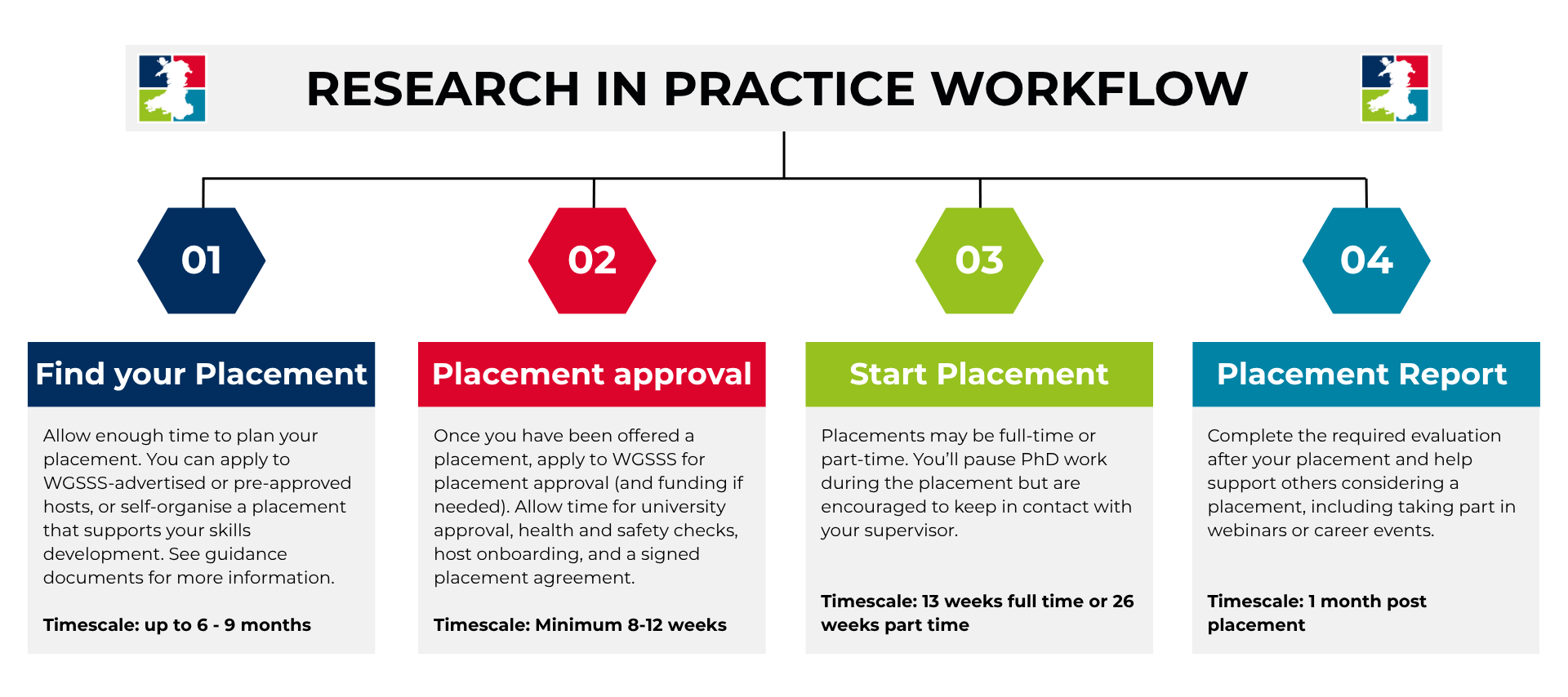
Step by Step guide

Ready to start your placement journey? Click the arrow beside each step to reveal guidance and key actions.
Step 1 – Prepare
Finding a placement requires preparation. Before you begin searching for opportunities, we recommend completing the following activities.
What to do
Attend a WGSSS Research in Practice information session.
These online sessions are delivered each semester and advertised through the WGSSS monthly newsletter and Teams channel. Sessions provide an overview of the scheme and an opportunity to ask questions.
Sessions are advertised monthly in the WGSSS newsletter, or email esrcrip@bangor.ac.uk to request a one to one meeting.
Discuss placement timing with your supervisor(s)
Before applying for a placement, discuss your plans with your supervisor(s).
Consider:
- Your research schedule and key milestones
- Progression review requirements
- When a placement will have the least impact on your PhD research
Review your Development Needs Analysis (DNA). Your placement should support your professional development and long-term career goals.
Consider:
- What skills you want to develop
- Areas where you would benefit from additional experience
- How a placement can contribute to your future career plans
Update your CV and application materials
Update your CV and refresh your application and interview skills. Your university’s Careers and Employability Service can provide support and guidance.
Key points
- Placements cannot be completed within the first 3 months of your PhD
- If you are applying in your final year, you must have at least six months remaining on your funding period at the start of the placement.
- Placements cannot be undertaken during your Master’s year.
- Focus on the skills and experience you want to gain, not just placements related to your research topic.
Timescale: Allow up to 6 months for planning, or longer when considering external schemes such as UKRI Policy Internships
Next Steps
- Read the placement guidance documents (top of this page)
- Complete the Expression of Interest form (bottom of this page)
Step 2 – Find a Placement
You can secure a placement in one of three ways:
WGSSS-Advertised Placements
Apply directly to opportunities advertised on the Placement Opportunities Page.
WGSSS works with host organisations across the public, private and academic sectors to develop placement opportunities which are advertised through the WGSSS website and Research in Practice Teams channel.
Each opportunity includes:
- A placement description
- Proposed activities and objectives
- Skills development
- Expected outcomes
- Application instructions
Researchers apply directly to the host organisation.
When submitting your application, please copy (cc) the inbox: esrcrip@bangor.ac.uk
The host organisation manages recruitment and makes the final selection of successful candidates.
We encourage researchers to consider opportunities beyond their immediate research area and focus instead on the skills and experience they wish to develop.
If you accept a placement, please email esrcrip@bangor.ac.uk
Please note: You may not be successful with your first application, so allow sufficient time for planning and applying.
External Placement Schemes
You may apply for opportunities through external placement programmes, such as
- UKRI Policy Internships
- Other doctoral placement or internship schemes
External placements must meet WGSSS and ESRC placement requirements, including duration and funding eligibility criteria.
If you are unsure whether an opportunity is eligible, contact esrcrip@bangor.ac.uk before applying.
Self-Organised Placements
You may arrange your own placement by approaching a suitable organisation directly and develop a placement that meets both your development needs and host requirements.
Key points
When developing a self-organised placement:
- Share the WGSSS Host Guidelines with the organisation
- Discuss potential activities and outcomes
- Ensure the placement supports your development needs
- Ensure the placement meets WGSSS requirements
- Consider affordability and travel commitments
Your supervisor may also be able to introduce you to contacts within their professional network. Once a placement has been agreed in principle, please email esrcrip@bangor.ac.uk so we can issue the Placement Application form for review and approval.
Timescale: Up to 6-9 months depending on recruitment timelines.
Placement eligibility at a glance
- Must meet ESRC/WGSSS placement requirements. See Guidance document
- Must support your skills and professional development
- Can be public, private, third sector or academic
- Can be in-person, remote or hybrid
- Must be approved by WGSSS before it begins
Placement Format
Placements may be:
- In-person
- Remote
- Hybrid
Researchers should, where possible, seek placements within reasonable commuting distance unless remote working is available or travel costs are covered
Step 3 – Get Placement Approval
Once you have secured a placement offer, apply for WGSSS approval before the placement begins. The Research in Practice Placement is a mandatory component of a WGSSS studentship and all placements must be approved to ensure they meet ESRC requirements and support your development needs
You will need to:
- Complete the WGSSS Placement Application Form.
- Obtain input from your host organisation and supervisor.
- Apply for placement funding (if required).
- Complete any host onboarding requirements.
- Complete any university approval processes (WGSSS can advise and co-ordinate).
Key points
- Submit your application at least 12 weeks before the placement start date.
- Applications received less than 8 weeks before the start date may delay commencement.
- A signed placement agreement and required approvals must be in place before you start.
Timescale: Minimum 8-12 weeks.
Step 4 – Start your placement
During your placement you remain a registered doctoral researcher at your home university.
Your responsibilities
• Maintain contact with your supervisor(s).
• Engage fully in placement activities.
• Complete any visa monitoring requirements where applicable.
• Raise any concerns with your host organisation, university, or WGSSS as soon as possible.
Student Visa Holders
• Researchers holding a Student Visa must continue to meet all university monitoring and reporting requirements to remain compliant with UKVI regulations.
Timescale: 13 weeks full time placement or 26 weeks part time placement
Step 5 – Placement Report
At the end of your placement, submit the required reporting and evaluation documents.
You will need to:
• Submit your End of Placement Report.
• Complete the placement feedback survey.
• Reflect on skills and experience gained
• Share outcomes and impact where appropriate
We recommend that students arrange a meeting with their Academic Supervisor to discuss their return to doctoral studies to ensure a smooth transition back to their PhD project.
Timescale: Within 1 month of completion
Ready to get started?
Submit your expression of interest for a placement here: https://forms.office.com/e/3bXfSchBGL
Placement Opportunities
View a list of currently advertised opportunities.
Placement First Thoughts
I’m really enjoying the placement so far, it has been a great way to gain a better understanding of the day-to-day within the civil service, the working style, and the differences from more academically focused research.
WGSSS Student Chloe Thompson, University of Gloucester, writes about her placement with the Welsh Government.

This placement is giving me the opportunity to apply behavioural science in real-world scenarios within public health. Alongside that, the placement is helping to enhance my research skills and better understand testing behaviours.
WGSSS Student Sherina Lowe, Cardiff Metropolitan University, writes about her placement with Cwm Taf Morgannwg Public Health.

Click here to read more Placement First Thoughts.
Important Information
All placements must meet ESRC placement criteria and cannot be paid in addition to your stipend. For questions or further guidance, please contact the Research in Practice Coordinator at: esrcrip@bangor.ac.uk